Introduction: To what extent did railroads drive economic growth in the United States during the postbellum era (1865–1900), and why did the North benefit more than the South? Why does this matter? According to the United States Department of the Interior, “In the period following the Civil War, railroads became the most important industry of the United States, as well as the dominant means of transportation.”[1] Additionally, the railroad business, by 1910, brought in “$328,478,000 in net earnings.”[2] As a result, railroads played a vital role in manufacturing by facilitating the movement of raw materials and finished goods, thereby supporting the construction of more durable buildings, homes, and textiles whose value persists in modern society.
Research Methodology: This blog employs a historical-analytical methodology, combined with comparative regional analysis and descriptive quantitative evidence.
The sources are appropriate because they are authoritative, drawing on primary government materials and peer-reviewed scholarship, and methodologically complementary, thereby enabling examination of the research question from multiple analytical perspectives.
Analytical Comparison: While railroads played a pivotal role in stimulating economic growth in the United States between 1865 and 1900, their impact was uneven: the North translated railroad expansion into sustained industrial growth due to its capital markets, manufacturing capacity, and urban connectivity, whereas the South’s war-damaged infrastructure, reliance on agriculture, and dependence on external investment constrained the economic returns of rail development. Why was there such inequality between the North and South?
To answer this question, one must examine the post-Civil War landscape. While the North emerged from the Civil War largely intact, the South suffered extensive physical and economic devastation. The South was broken not only by the process of rebuilding but also by its continued reliance on local and individual companies to manufacture primarily agricultural products, including cotton. Concerning this, Lawrence McDonald’s review of Gavin Wright’s book, he quotes Wright, “The South’s reliance on slavery precluded development of labor-market links with the North and West, maintaining a regime of high-priced labor. Plantations flourished, but towns, railroads, and manufacturing development lagged.”[3] In other words, wartime damage delayed reconstruction, and the South’s commitment to an agrarian economic structure limited diversification in the transport of other goods, for which railroads would be best suited. Moreover, the South had to develop new fabrication methods, which took time. Due to these circumstances, the South lagged in manufacturing essential products such as iron, steel, and coal, thereby leaving the North better positioned to produce these goods. According to the National Park Service, “By 1860, 90 percent of the nation’s manufacturing output came from northern states.”[4]
Although the above is mentioned, one can dimly see why the North progressed at a much faster pace; there are additional specifics to consider. The Smithsonian American Art Museum offers an insightful discussion that deepens understanding of this issue: “The North had a greater advantage over the South in terms of its human, natural, and industrial resources, but it was the effective application of these resources which provided the greatest windfall for the Union.”[5] Because Northern cities were located close to one another and to established industries, the region could mobilize its resources far more easily. In contrast, the South’s vast rural landscape supported fewer urban centers, whereas the North, though smaller in area, contained more cities, greater manufacturing capacity, and a larger population.
All of these helped the railroad business increase in productivity and profitability. Regarding industrial resources, the North also succeeded in operating businesses owing to its organizational capabilities. Alfred Chandler states that, “Such economies [profitable] depend on knowledge, skill, experience, and teamwork.”[6] These examples demonstrate how the North enhanced its railroad organizations to increase profitability and directly influence the American landscape and businesses.
Critics in both the North and South argued that railroads did not trigger a revolution and were unnecessary. One critic was Robert Fogel. In his book, Railroads and American Economic Growth, he argues, “The products of agriculture [and other goods] could have been carried solely by wagon and water.”[7] Furthermore, he builds his case by analyzing data to demonstrate that railroads did not reduce the prices of goods and services and, in fact, that railroad mileage occupied land and was unnecessary. To disprove this point, the following graph shows how much the North (Midwest included) grew more than the South, as well as how much mileage the railroad took. Notably, the mileage indicates the number of jobs created and reflects increased capacity for generating revenue.
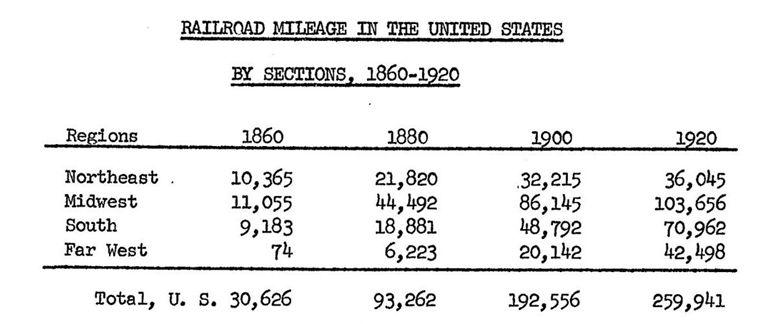
Figure 1. Railroad Mileage in the U.S.: U.S. Department of the Interior, The National Survey of Historic Sites and Buildings: Theme XVII-b, Commerce and Industry. Volume I: The Historical Narrative (Washington, DC: U.S. Government Printing Office, 1966), 54.
Despite his claims, one cannot ignore the evidence of what the railroads brought to America: they created far more jobs and could carry more essential freight, such as steel, iron, and coal, which transformed the American landscape and economy.
Concluding statement: In conclusion, railroads emerged as the defining infrastructure investment of the postbellum economy, with regional comparisons revealing that Northern expansion amplified industrial growth (90 percent of the nation’s manufacturing output), whereas Reconstruction-era constraints limited Southern recovery. As a result, railroads became a key driver of market integration and long-term regional divergence.
[1] U.S. Department of the Interior, The National Survey of Historic Sites and Buildings: Theme XVII-B, Commerce and Industry (Washington, DC: U.S. Government Printing Office, 1966). https://npshistory.com/publications/nhl/theme-studies/commerce-industry-1.pdf.
[2] U.S. Department of the Interior, National Survey of Historic Sites and Buildings, Theme XVII-B.
[3] McDonnell, Lawrence T, “Old South, New South: Revolutions in the Southern Economy since the Civil War,” Review of Old South, New South by Gavin Wright, Technology and Culture 30, no. 3 (1989): 695–97. https://doi.org/10.2307/3105986.
[4] Benjamin T. Arrington, “Industry and Economy during the Civil War,” National Park Service, last updated August 23, 2017, accessed January 29, 2026, https://www.nps.gov/articles/industry-and-economy-during-the-civil-war.htm
[5] American Experience, “How the Railroad Won the War,” Smithsonian American Art Museum, Accessed January 27, 2026. https://americanexperience.si.edu/wp-content/uploads/2015/02/How-the-Railroad-Won-the-War.
[6] Alfred D. Chandler, “Organizational Capabilities and the Economic History of the Industrial Enterprise,” The Journal of Economic Perspectives 6, no. 3 (1992): 79–100. http://www.jstor.org/stable/2138304.
[7] Robert William Fogel. Railroads and American Economic Growth: Essays in Econometric History. (Baltimore: Johns Hopkins Press, 1970) 51.
 Lattes and Logic
Leave a comment