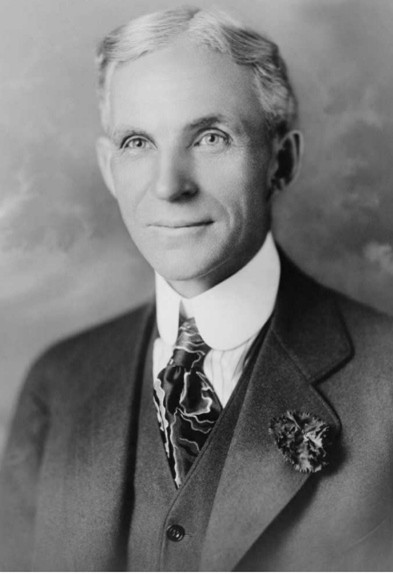
Henry Ford did not invent the automobile, but he did have a passion for cars and built one in his backyard by 1896. The first automobile was created by the German Carl Benz a decade earlier. Ford is often credited with creating the first auto assembly line, but that invention belongs to Ransom Eli Olds in 1901.[1] What did Ford do for the industry? He improved the assembly line by inventing the first movable assembly line in 1913. Ford got his idea from visiting a Chicago meat-packing plant. Upon visiting this plant, he stated, “The idea came in a general way from the overhead trolley that the Chicago packers use in dressing beef.”[2] As a result, this accelerated automobile manufacturing, increased production, and reduced costs. This effect made the car affordable to the working class, popularizing the automobile.
At a time when most industrialists prioritized production and profit above all else, Ford introduced the five-dollar daily wage, arguing that improving workers’ wages and working conditions would enhance productivity and reduce labor turnover. Ford’s $5 wage was a groundbreaking economic policy that transformed labor relations, productivity, and consumer culture in the United States.
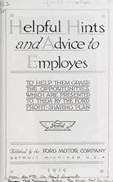
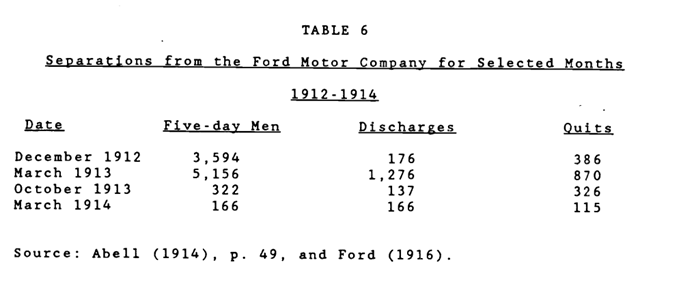
In 1914, Henry Ford adopted a different approach, paying workers $5 per day for a 40-hour workweek. He called this compensation “profit sharing”.[3] At a time when workers were overworked and paid low wages, the turnover rate was high; however, Ford’s virtually disappeared. Jason Taylor in the Journal of Labor Research gives details of the $5 workday: “Turnover at Ford factories fell from 370 to 16 percent; productivity rose between 40 and 70 percent; and profits increased approximately 20 percent within a year of the announcement of the wage increase.”[4] The following table shows precise data on the dramatic decrease in turnovers from 1913 to 1914.
Picture source (above): Ford Motor Company, Helpful Hints and Advice to Employees to Help Them Grasp the Opportunities which are Presented to Them by the Ford Profit-Sharing Plan (Detroit, MI: Ford Motor Company, 1915
This new model of higher wages and profit sharing, known as Fordism, enabled workers to become consumers of the very product they produced. This new manufacturing method provided significant advantages for Ford. By introducing the moving conveyor belt into automobile production, he dramatically increased output, thereby reducing the cost of producing the Model T. The following chart shows the increase in production. In turn, this enabled Ford to provide more to his workers. In short, increased productivity led to lower prices for Ford and consumers, which in turn led to higher wages and greater stability.
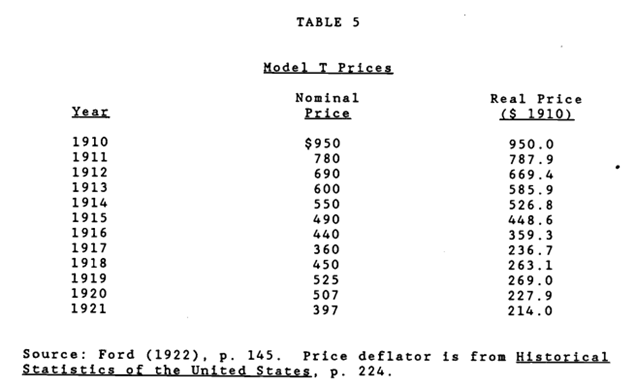
Because inside the factory saw lower costs and higher productivity, the public was able to afford the Model T, which helped stimulate mass consumption and contributed to the growth of a consumer economy. Michel Aglietta, in his book, explains the impact of Fordism this way: “It denotes a series of major transformations in the labor process closely linked to those changes in the conditions of existence of the wage-earning class that give rise to the formation of a social consumption norm.”[5] Needless to say, Fordism stimulated the growth of the middle class.
Despite its apparent generosity, Ford’s five-dollar workday was not without conditions. Participation in the program required employees to conform to specific moral and social standards established by the company. Ford’s employee handbook, Helpful Hints and Advice to Ford Employees, outlined expectations for employees’ personal lives, including the type of housing they should purchase and the neighborhoods in which they should live. The handbook advised that “Employees should avoid the congested and slum parts of the city. The Company will not approve men who herd themselves in overcrowded boarding houses which menace their health.”[6]
In addition to housing guidance, the pamphlet prescribed standards for maintaining a clean and orderly household, instructing workers: “Do not allow any refuse or garbage to remain in the house or on the premises, but see that it is either buried or burned.”[7] Finally, Ford created a Sociological Department of investigators to oversee these requirements and ensure compliance with the rules. These requirements demonstrate that Ford’s wage policy functioned not only as an economic incentive but also as a mechanism of social oversight and control.
This type of oversight and control did not go unnoticed by factory workers. The workers got tired of the personal investigations and intense oversight. Stefan Link states in his journal, “Unskilled operatives resented the intrusions of the Sociological Department.”[8] Furthermore, Links explains the workers’ response when this department was disbanded: “The shop floor greeted the end of the Sociological Department with a great sigh of relief.”[9] Publicly, Ford was criticized for being overly paternalistic and for attempting to control his workers outside the workplace. Eventually, Ford’s program got too expensive, and he had to abandon it. Many critics saw this program failing from the beginning espeically due to the paternalistic nature of it. Moreover, due to the war, resession, and cost of this program, it did not last long.
Although Ford’s program ended prematurely, its influence endures. It demonstrated the central importance of efficiency in factory production, established a model for prioritizing investment in workers before profit, and helped popularize the eight-hour workday, showing that shorter hours could boost productivity and reduce turnover. Most importantly, he revolutionized the production and sale of motorcars, uniting the vision of an innovator with the drive, discipline, and relentless energy needed to turn an ambition into reality.
[1] David Long, Henry Ford: Industrialist (New York, NY: Cavendish Square Publishing LLC, 2016), 3.
[2] Henry Ford and Henry Ford III, My Life and Work (New York: Open Road Integrated Media, Inc., 1922), 67.
[3] Ford Motor Company, Helpful Hints and Advice to Ford Employees (Detroit: Ford Motor Company, 1915), 1, https://www.thehenryford.org/collections-and-research/digital-collections/artifact/255638/#slide=gs-673952.
[4] Jason E. Taylor, “Did Henry Ford Mean to Pay Efficiency Wages?” Journal of Labor Research xxiv, no. 4 (Fall 2003): 683, https://link.springer.com/content/pdf/10.1007/s12122-003-1020-3.pdf.
[5] Michel Aglietta, A Theory of Capitalist Regulation: The US Experience, trans. David Fernbach (London: Verso, 1979).
[6] Ford Motor Company, Helpful Hints and Advice to Ford Employees, 13.
[7] Ford Motor Company, Helpful Hints and Advice to Ford Employees, 19.
[8] Stefan Link, “The Charismatic Corporation: Finance, Administration, and Shop Floor Management under Henry Ford,” Business History Review 92, no. 1 (2018): 109. https://doi.org/10.1017/S0007680518000065.
[9] “The Charismatic Corporation,” 110.
By: Jonathan White
Contact: whitejonathan173@whitejonathan173

 Lattes and Logic
Leave a comment