This study examines how Puritan theology and political thought functioned as a formative “seedbed” for the American Revolution and the founding of the United States. Tracing a continuity of ideas from the early Puritan founders of New England and the Massachusetts Bay Colony to later intellectuals such as Ezra Stiles demonstrates how biblical reasoning was employed to justify and shape revolutionary ideology.
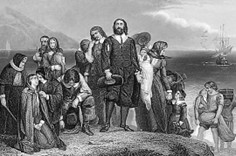
John Winthrop, who led the first group of Puritans to North America in 1630 with about 700 passengers aboard 11 ships, played a key role in founding Massachusetts. Calling himself governor, Winthrop believed Christians in the new world would start a civilization that would serve as a light to the world, or as he described it, “a city on a hill.” Additionally, he envisioned this new colony as separatist, calling it the “New Zion”. This “New Zion” conveyed a sense of separation and sanctity. In short, Winthrop envisioned them as a holy community that must live according to the Word of God in every way, both among themselves and outside it. (Picture- Kamrath, Angela E. “Who Founded Massachusetts in America? Why? John Winthrop & the Puritans Founded the Self-Governing Colony of Massachusetts for Religious Freedom and Self-Government.” American Heritage Education Foundation. June 15, 2017.)
John Cotton was a major figure in establishing the Massachusetts Bay Colony’s theological framework. He advised and influenced society and politics through sermons and writings. He sought to construct a system of civil government based directly on biblical law. For example in An abstract of laws and government which is a key document in understanding early Puritan political thought in colonial New England, he writes, “They [Colonists] understand what kind of government they would want, and (if they were encouraged and supported) they could clearly demonstrate it from the true Scriptures—both what its laws should be and what kinds of officials there should be, from the highest to the lowest.”[1] This illustrates the fusion of theology and politics in colonial New England and provides a foundation for later American ideas about law, authority, and moral order.
In fact, Cotton’s political ideas were solidified in the Massachusetts Body of Liberties (1641). This document is often viewed as a precursor to the General Laws of Massachusetts and the Massachusetts Constitution. Notably, it was the first legal code to incorporate liberties for its citizens, influencing similar rights in the Bill of Rights. Comprising one hundred laws and liberties, it is summarized by the statement: “On this day, we reverently and unanimously declare and establish the following rights, liberties, and privileges relating to both our churches and our civil society, to be fairly, equally, and permanently enjoyed and upheld throughout our jurisdiction forever.”[2] The spirit of this document reveals how deeply early New Englanders understood political stability to rest on the secure, shared enjoyment of moral and religious liberty.
Carrying this idea into the early stages of the Revolution, Ezra Stiles, a Congregational minister and theologian, served as president of Yale College from 1778 to 1795, framing political events within biblical and historical traditions familiar to colonial audiences. In a letter reflecting on the growing imperial crisis, Stiles insisted that such oppression could not endure, writing, “No political leader in Europe, and not a single serious observer in America, believes that the ever‑growing millions of this continent will permanently submit to oppression. There are many possible forms of resistance. We should not be discouraged if everything fails until the very last measure, whose success cannot be doubted.”[3] For Stiles, the scale of American society and the injustice of imperial policy made resistance not merely possible, but ultimately unavoidable.
In conclusion, Puritanism functioned as more than a religious movement in early America; it provided a durable intellectual and moral foundation upon which revolutionary ideas could later take root.
[1] John Cotton and William Aspinwall, An Abstract of Laws and Government: Wherein as in a Mirrour May Be Seen the Wisdome & Perfection of the Government of Christs Kingdome, Accomodable to Any State or Form of Government in the World That Is Not Antichristian or Tyrannicall (London: Printed by M. S. for Livewel Chapman, 1655), accessed April 12, 2026, https://link.gale.com/apps/doc/CY0112702697/SABN.
[2] Francis Bowen, Documents of the Constitution of England and America, from Magna Charta to the Federal Constitution of 1789 (Cambridge, MA: J. Bartlett, 1854), accessed April 12, 2026, https://link.gale.com/apps/doc/CY0100143722/SABN.
[3] Abiel Holmes, The Life of Ezra Stiles, D.D., LL.D.: A Fellow of the American Philosophical Society; of the American Academy of Arts and Sciences; of the Connecticut Society of Arts and Sciences; a Corresponding Member of the Massachusetts Historical Society; Professor of Ecclesiastical History; and President of Yale College (Boston: Printed by Thomas & Andrews, 1798), accessed April 12, 2026, https://link.gale.com/apps/doc/CY0100529029/SABN.
Jonathan White
Contact: whitejonathan173@gmail.com
 Lattes and Logic
Leave a comment